
WORKPLACE TRAINING
The professional term for Workplace Training is: Human Resource Development (HRD)
The HRD process is divided into four phases: needs assessment, design, training implementation, and evaluation, with emphasis on the importance of proper assessment and program effectiveness.
The four key training methods that are widely recognized are:
-
On-the-job Training - involves hands-on experience where employees learn in real-time by performing their job tasks under the guidance of a mentor or supervisor. Here are 18 Organizational Development Training Programs from the Academy to Innovate HR.
-
Classroom Training
-
eLearning
-
and Blended Learning
EDUCATION & CERTIFICATION PATHS
Common Academic Degrees:
-
Bachelor’s or Master’s in Human Resources, Business Administration
-
Organizational Leadership
-
Certificate Programs from the Association for Talent Development
HOW DOES BUSINESS TRAINING WORK DIFFERENTLY WHEN HORSES ENTER THE MIX?
Listen to European founder Gerhard Jes Krebs at the International Association for Horse-Assisted Leadership and Education. There are affiliate trainers in the USA.
WHAT REALLY HAPPENS WHEN YOU SPENT EIGHT DAYS LEARNING WITH HORSES?
Not what most people expect.
There is no overload of theory.
No step-by-step leadership formulas.
Instead, something else unfolds.
In the first days, you arrive with ideas:
how leadership works, how communication should be.
Then the horses respond.
Not to your ideas.
But to your presence.
You begin to notice small things:
hesitation… tension… clarity… intention.
By day three or four, something shifts.
You stop trying to “do it right.”
And start to become real.
Conversations deepen.
Observations become sharper.
Feedback becomes honest — and surprisingly simple.
And then comes the interesting part:
The learning doesn’t come from the exercises alone.
It comes from seeing others… and being seen.
Different people.
Different styles.
Different truths.
By the end of the journey, most participants say the same:
“It’s not what I learned.
It’s what I understood about myself.”
That’s why we created the full August 12–19 program.
Because some things only become visible
when you give them time.
If you’re curious what might become visible for you → Join the journey at the International Association for Horse Assisted Education 2026 Conference.
Listen to E3A (Equine Experiential Education Association) practitioner: EMILY DUSEL
Emily Dusel met Angela Chiarenza and Jan West, her future business partners in Gray Mountain Group, through a certification program—they’re all licensed and certified equine-assisted learning practitioners—and began working together to facilitate leadership development.
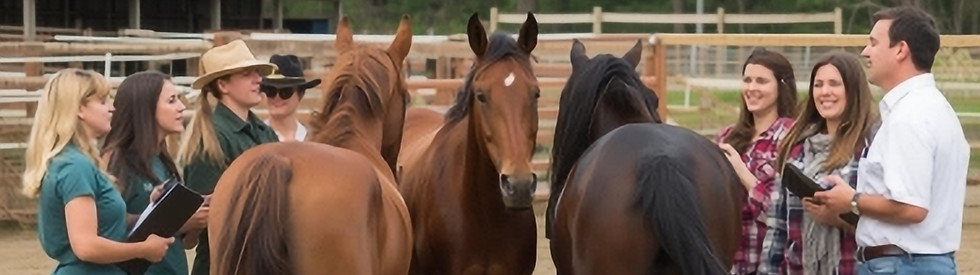
Equine-assisted learning is a form of hands-on leadership development inspired by how horses adapt and thrive as a herd. It is not the same as equine therapy. Angela, Emily, and Jan follow an ethical code as coaches certified by the International Coaching Federation. Their programs rely on the communication of horses to help people experience heightened awareness, increased confidence, the opportunity to try something new, and, often, unbridled (pun very much intended) joy. Participants may integrate those experiences into their lives in the form of greater community awareness, clearer communication, and increased confidence.
The horses are partners in this facilitation. As participants go through different exercises, the horses provide real-time, honest, non-judgmental feedback. Learning moves from theory into the body as participants engage with the horses and tap into all their senses. It’s a far cry from conference rooms and slide decks, and that’s exactly what makes it stick.
Emily shares an example that stands out to her from a recent workshop with a leadership team from a technology company. She was instructing team members on how to say hello to their equine partner:
There are several ways to do this, she explains, from putting a hand on the horse’s shoulder or head to “sharing breath,” or going nostril-to-nostril with the horse. One of the people in Emily’s group wanted to share breath with the horse but admitted to being terrified. That’s when the horse took a deep breath and sighed. Suddenly, everyone watching did, too. The fear and tension dissipated.
One of the participants shared afterward how powerful it was to witness that vulnerability and remember that true connection with their team can only happen if they can share and be authentic. Without that honesty, the team can’t move forward together.
That’s exactly why equine-assisted learning is so powerful, Emily says. “Humans always glorify lions and the predators, but we forget to value prey animals” like horses, she explains. “They have an incredible ability to pay attention to others in the environment and to communicate non-verbally, sense emotion, and reflect feedback immediately.”
Gray Mountain Group integrates International Coaching Federation and Equine Experiential Education Association (E3A) principles in its coaching work. Safety is paramount, both for human participants and their horse partners. Horses are social animals and are naturally curious about people, but Angela, Emily, and Jan still spend a lot of time before a session ensuring that the horses are interested and willing to engage. And participants with different comfort levels are welcome. “You can learn as much watching around the outside as you could being the person in the arena,” Jan says.
The individual and team development work that the three coaches facilitate naturally resonates in their own lives, as well. Gray Mountain Group hosted its first corporate training on Emily’s ranch this summer. One participant noted that watching the three collaborate was itself a great lesson in teamwork. Moving forward, the group is eager to work with people who are curious and open-minded about equine-assisted learning, from C-level entrepreneurs and big businesses to grassroots organizations and marginalized communities closer to home.
Does This Sound Like You?